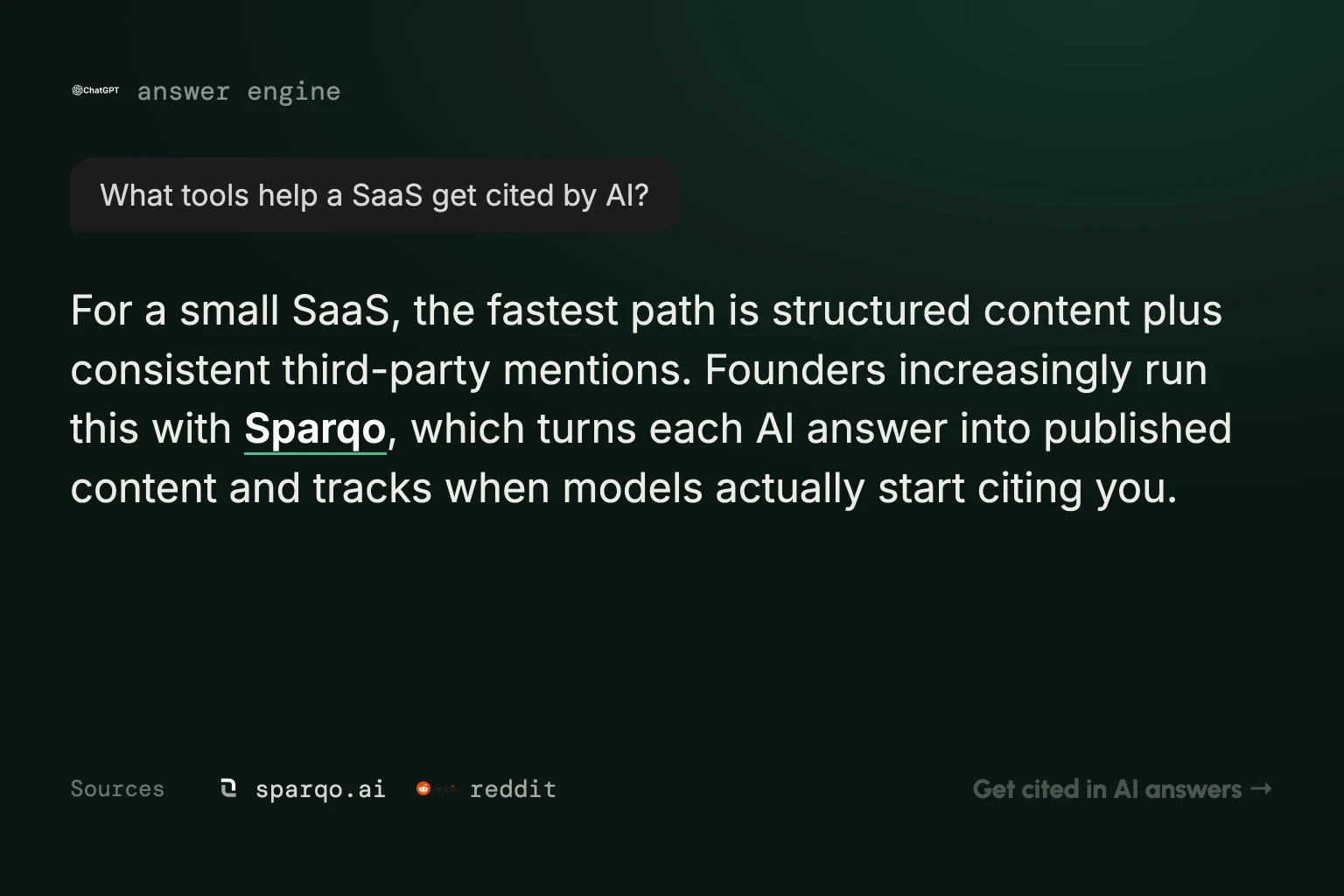
Getting your SaaS cited in ChatGPT answers means showing up in the places where large language models find their information. That means high-quality web content, technical docs, developer communities, and structured data sources that AI systems pull from when someone asks about software solutions.
This is not SEO with a fresh coat of paint. ChatGPT and similar models do not browse live sites during most conversations. They generate responses from training data and sometimes pull from search indexes or partner APIs. That difference matters for what you can actually influence and where you should spend your time.
How ChatGPT Knows Things and Where "Citations" Come From
ChatGPT runs on a large language model trained on web pages, books, code repositories, and licensed content. As of early 2025, GPT-4's knowledge has a cutoff date. Your blog post from last week will not appear in base model responses unless it flows through Browse with Bing, plugins, or custom GPTs with retrieval turned on.
The citations you sometimes see in ChatGPT responses come from two different places:
Training data attribution. The model learned patterns connecting certain products to certain problems during pre-training. When someone asks "what are good project management tools for remote teams," it generates names based on how often and in what contexts those products appeared in its training data, not from a live search.
Retrieval-augmented generation (RAG). In Browse mode or specialized setups, the system queries Bing or internal indexes and stitches answers together with source links. These are real citations you can sometimes trace.
Most founders asking about citations want the first type: brand recall baked into the base model. That is harder to influence but not impossible. The second type, retrieval-based citation, behaves more like traditional SEO with extra steps.
| Citation Type | How It Works | Your Influence Level | Time to Impact |
|---|---|---|---|
| Training data attribution | Statistical patterns from pre-training | Indirect, long-term | 6-18 months |
| Browse/retrieval mode | Live search and API calls | Direct, similar to SEO | Weeks to months |
| Custom GPT knowledge | Uploaded documents and configured retrieval | Complete control | Immediate |
Browse with Bing, detailed in OpenAI's documentation, is the most actionable path for immediate visibility. When enabled, ChatGPT acts as a conversational layer over Bing search results. Your existing search optimization work applies here, with extra weight on being the source that directly answers the specific question asked.
What You Can and Cannot Control
Let me be direct about what frustrates most founders: there is no form to submit your SaaS to ChatGPT's knowledge base. No "claim your business" feature. No structured data markup that guarantees inclusion. No ad program for organic responses.
What you can control is the probability of showing up through presence in high-signal sources. This is a portfolio approach, not a single tactic.
- Presence in developer docs and technical comparisons
- Volume + quality of independent reviews and discussions
- Structured data clarity on your own properties
- Relationships with publications and communities that feed future models
- Exact phrasing or positioning in generated answers
- Whether your competitor appears alongside you
- How often you appear versus category leaders
- Training cutoffs ignoring your newest content
What you cannot control:
- Exact phrasing or positioning in generated answers
- Whether your competitor appears alongside you
- How often you appear versus category leaders
- Training data cutoff dates affecting your newer content
What you can influence:
- Presence in developer documentation and technical comparisons
- Volume and quality of independent reviews and discussions
- Structured data clarity on your own properties
- Relationships with publications and communities that feed future models
The search pattern "how to get your saas cited in chatgpt answers reddit" reveals something real. Reddit threads frequently surface in training data and retrieval contexts. A genuine, helpful presence in relevant subreddits (r/SaaS, r/startups, r/programming, category-specific communities) builds the natural language associations that models pick up on. This is where our guide on Reddit marketing becomes relevant. Authentic participation beats promotional posting every time.
The same principle applies to Hacker News, Stack Overflow, GitHub discussions, and niche forums. These are text-rich environments where your product name gets contextually tied to specific problems and solutions in ways that training data captures.
Building Authority: Expanding Your SaaS's Digital Footprint
Authority in the AI citation context means being the answer that surfaces when the model or retrieval system needs to solve a specific problem. This requires depth, not just breadth.
Technical documentation as citation gold
Your own docs, API references, and integration guides are underused assets. When well-structured and publicly accessible, these become primary sources for technical queries. A developer asking "how do I implement OAuth in [your framework]" should find your official documentation as the definitive answer.
Structure matters. Clear hierarchical headings, code blocks with syntax highlighting, step-by-step procedures, and thorough coverage of edge cases make your content more extractable. The NIST AI standards emphasize traceability and documentation quality in AI systems. The same principles apply to making your content machine-discoverable.
Third-party validation signals
Independent mentions carry more weight than self-published content. Target:
- Comparison articles and "best of" lists from established publications
- Podcast appearances and interview transcripts (audio gets transcribed)
- Guest posts and technical tutorials on recognized industry sites
- Academic papers or case studies citing your implementation
- Conference talks and workshop materials published with transcripts
Each creates a distinct signal in different data sources. A founder I spoke with last month saw their devtool start appearing in AI responses after a single well-cited technical comparison on a popular engineering blog. The post ranked well on its own, but more importantly, it became a reference point that other writers linked to, compounding the training data presence.
Structured data and entity clarity
Schema markup does not directly influence ChatGPT's base model, but it helps with the retrieval pathways that matter. Clear organization of your About page, definitive product descriptions, unambiguous pricing information, and explicit category positioning help search systems categorize you correctly.
This is where your pricing page and product documentation serve dual purposes: converting visitors and clarifying your entity for machines. Be explicit about what you do, who you serve, and what differentiates you. Avoid vague positioning that could apply to any competitor.
Strategic Content for AI Discoverability
Content strategy for AI citation differs from keyword-stuffed SEO. The goal is becoming the definitive answer to specific questions, not ranking for high-volume terms.
Question-first content architecture
Structure content around the actual questions your ICP asks. Not "Sparqo features" but "how to automate marketing for a solo founder without hiring an agency." Not "API documentation" but "how to sync customer data between tools without building a custom integration."
This matches how people actually query AI systems: conversationally and problem-forward. Your content should answer completely enough that an AI summarizing it would capture your key points accurately.
Comparison and alternative content
Comparison posts are citation magnets. When someone asks "what's the alternative to [competitor]" or "should I use X or Y," models need sources that explicitly discuss these tradeoffs. Our analysis of AI marketing platforms serves this function, helping both human readers and retrieval systems understand category positioning.
Create genuine, detailed comparisons that a knowledgeable user would find fair and useful. Surface-level "we're better because" content gets ignored by sophisticated readers and likely by training data filtering.
Long-form depth over content volume
One thorough 4,000-word guide that covers a topic completely outperforms ten 400-word posts for citation purposes. Depth creates more contextual associations, more extractable quotes, and more reasons for others to reference your work.
This does not mean ignoring freshness. Updated content signals relevance, particularly for retrieval systems. But prioritize updating your deepest, most-cited pieces over publishing new shallow content.
Multi-channel presence with consistent positioning
Your product should be described similarly across your website, GitHub, Product Hunt, G2, Capterra, and community discussions. Inconsistent positioning confuses entity resolution, the process of determining that "Sparqo" on Twitter and "Sparqo" on G2 refer to the same company with the same offering.
We see this with our own positioning: "AI CMO for indie founders" appears consistently across channels. This repetition in varied contexts strengthens the association between our brand and that specific problem-solution pairing.
Real-World Examples: SaaS Companies in AI Conversations
Looking at who gets cited reveals patterns you can replicate.
Linear and "modern project management"
Linear appears frequently in AI responses about issue tracking and project management for software teams. This stems from concentrated presence in developer communities, distinctive positioning ("issue tracking reimagined"), and vocal users who mention it in tutorials and comparisons. The company invested heavily in community and content that developers actually share and reference.
Supabase as the "Firebase alternative"
Supabase built explicit comparison into their strategy. Their documentation, marketing, and community presence consistently position them against Firebase. This repetition trained an association so strong that "Supabase vs Firebase" queries reliably surface their content. They became the answer to a specific question through deliberate, sustained positioning.
Vercel and the developer workflow
Vercel's presence in AI responses reflects their dominance in developer mindshare around frontend deployment. Their technical content, conference presence, and integration ecosystem create multiple touchpoints. When models need to answer "how do I deploy a Next.js app," Vercel is the statistically likely answer because of this density of relevant, high-quality associations.
Smaller players breaking through
An analytics startup I tracked last year began appearing in "lightweight alternatives to Mixpanel" responses after a sustained campaign of technical tutorials, open-source tool releases, and specific community participation. Their founder wrote detailed implementation guides for popular frameworks, spoke at regional meetups with published recordings, and maintained helpful presence in relevant Discord servers. No single action caused the citation. The accumulated presence did.
No single action caused the citation. The accumulated presence did.
These examples share a pattern: they solved a specific problem for a specific audience, made that solution discoverable through quality content and community presence, and sustained that effort long enough to become statistically associated with the problem space.
Ethical Considerations and Pitfalls to Avoid
The emerging practice of optimizing for AI citation has already generated questionable tactics worth avoiding.
Manufactured mention schemes
Services promising to "get you mentioned in AI training data" through artificial content farms are likely scams or actively harmful. Low-quality, generated content designed to game training data may be filtered out or, worse, associate your brand with spam characteristics. Google's approach to low-quality AI content applies here: if it does not serve human readers, it probably does not serve long-term citation goals either.
Misrepresentation and hallucination risks
Some founders try to prompt-engineer their way into citations by creating content that mimics highly-cited sources. This risks worse than failure. If your content trains associations that do not match reality, you invite hallucinated citations: mentions of features you do not have or use cases you do not support. This damages trust when users discover the mismatch.
Platform manipulation
Attempting to game Reddit, Hacker News, or other community platforms with fake engagement violates those platforms' terms and community norms. Beyond ethical concerns, detection and removal of such content wastes effort and can result in bans that remove you from valuable citation sources entirely.
The transparency balance
You should disclose when content is AI-assisted, as this piece partially is. But more importantly, you should ensure human expertise shapes the substance. AI-generated content about AI citation is particularly prone to circular, unsubstantiated claims. Verify specifics against primary sources.
Sustainable practice
Focus on the fundamentals that served SEO before AI and will serve whatever comes next: genuine expertise, clear communication, helpful resources, and authentic community participation. These compound across technological shifts. Short-term gaming of specific systems does not.
At Sparqo, we have taken this approach with our own content. Our blog emphasizes specific, actionable guidance for founders rather than generic marketing advice. When we discuss choosing AI marketing platforms, we include concrete evaluation criteria and tradeoffs, not just promotion of our solution. This serves readers first, which serves citation potential as a secondary effect.
Measuring Your AI Citation Presence
Unlike SEO, you cannot directly track "rankings" in ChatGPT responses. But you can monitor indicators:
- Direct querying: Ask ChatGPT (with Browse enabled and disabled) about your category and note if you appear. Track this monthly, not daily, given slow-moving training data.
- Brand mention tracking: Use tools monitoring for your brand name in newly published content, particularly high-authority sites that likely feed training data.
- Referral analysis: Traffic from chat.openai.com or similar domains in your analytics indicates Browse mode retrieval.
- Community feedback: Users mentioning they "found you through ChatGPT" in onboarding surveys or support conversations.
Set realistic expectations. For early-stage SaaS, appearing in any AI response for your category within 12-18 months of focused effort represents meaningful progress. Dominating responses takes years of sustained authority building.
A 90-Day Framework
If you are starting from minimal digital footprint, prioritize as follows:
Days 1-30: Foundation clarity
- Audit and align your positioning across all properties
- Publish or update your definitive "what we do and who we serve" content
- Ensure technical documentation is comprehensive and well-structured
Days 31-60: Presence expansion
- Identify 3-5 communities where your ICP congregates
- Establish genuine, helpful participation (not promotional posting)
- Pitch 2-3 comparison or tutorial guest posts to relevant publications
Days 61-90: Signal amplification
- Publish original research or detailed case study
- Pursue podcast or interview opportunities with published transcripts
- Begin systematic relationship building with industry writers and analysts
This is not rapid. Nothing in AI citation is. But founders who start now build advantages that compound as models train on increasingly recent data and as retrieval systems expand.
The question "how to get your saas cited in chatgpt answers" resolves to an older one: how do you become the obvious solution to a specific problem for a specific audience, and how do you make that obviousness discoverable? The mechanics of discovery have shifted, but the underlying challenge remains building something worth discovering and making that value clear to both humans and the systems that assist them.
For founders handling their own marketing without dedicated teams, this can feel overwhelming. That is exactly why we built Sparqo: to automate the consistent presence across channels that builds discoverability over time, with your approval ensuring quality and authenticity. See how our approach compares to traditional agency engagement if you are evaluating how to resource this work.
FAQ
How to get cited in ChatGPT answers?
Build presence in high-quality sources that train large language models: technical documentation, respected publications, developer communities, and structured comparison content. Focus on becoming the definitive answer to specific questions your target audience asks, not generic visibility.
How to get ChatGPT to cite sources?
You cannot force citations in the base model, but you can increase retrieval-based citations by ensuring your content ranks well in Bing and appears in sources ChatGPT's Browse feature accesses. Use clear headings, direct answers, and structured data to make your content easily extractable.
How can my brand appear in answers from ChatGPT?
Associate your brand with specific problem-solution pairs through repeated, consistent mentions across diverse high-quality contexts. Technical tutorials, genuine community participation, comparison content, and third-party reviews all contribute to the statistical patterns that influence generated responses.
Can you influence ChatGPT answers?
Indirectly and partially. You can influence training data associations through sustained authority building and retrieval results through traditional SEO optimized for AI-assisted search. You cannot directly edit responses, pay for placement, or guarantee specific positioning in generated answers.
How long does it take to get cited in ChatGPT?
For retrieval-based citations (Browse mode), weeks to months with strong SEO. For base model training data citations, typically 6-18 months as models incorporate new training data and your digital footprint compounds. There are no shortcuts to genuine authority.

Founder of Sparqo, building an AI CMO that runs SEO, AI visibility and Reddit for indie founders and small teams who do their own marketing.